Friday, September 17, 2010

9/17/10 Basic Drawing


Today's Class- Today we started our study of line. We viewed some slides showing how line has been used in art from prehistoric times to the present. Then the class did some exercises in contour line drawing, with shoes as the subject.

How to make this up- Find a shoe, something with a full upper portion (not a sandal/flip flop). You will do the following drawings from your shoe using pencil line:

Exterior Contour- A single line that surrounds and describes the silhouette of the shoe. No interior structures should be shown. Four examples can be seen in the above photo, and in the bottom left of the photo below. Pay attention to shoe proportions (height to length, relative locations of details) and to the edge. We spent 30 minutes on this exercise, with students drawing between 1 and 6 shoes.

Cross Contour- The artist draws perceived lines that represent the volume of the shoe and movement over its surface. The lines provide clues as to the true 3 dimensional shape of the shoe. Use lines in multiple directions, and they may intersect with each other. There is one example in the above photo, and in the upper left of the photo below. Students spent 30 minutes drawing one shoe in cross contour.

Blind Contour- The shoe is drawn, looking only at the shoe, not at the paper. Let your eye follow a path around the exterior contour of the shoe, paying close attention to details of the edge, moving your pencil to match. See the upper right of the photo below for examples. The slower you draw, the better the result will be. Students spent 15 minutes on this exercise, drawing anywhere from 4 to 12 shoes.

Final Shoe- The last exercise was to draw one fully rendered shoe, including all details of structure and surface. Use cross contour to whatever extent you want. Line only, no shading. An example can be seen in the lower right of the photo below. Students spent 30 minutes drawing the one shoe.

This is a portfolio exercise, which must be made up by the midterm portfolio collection- 10/29/10.
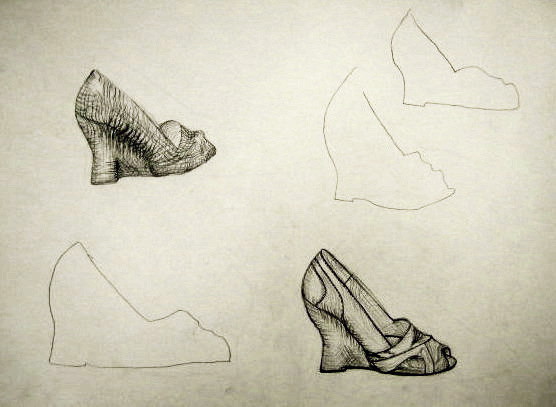
Clockwise from bottom left- exterior
contour, cross contour, blind contour,
fully rendered final shoe


Homework- In your small sketchbook, draw ten line drawings of shoes, one per page. Include the following:

8 pages of exterior contour drawings (just the silhouette)
1 page cross contour drawing
1 page fully rendered shoe

Use whichever pencil(s) you want. Line only, no shading. You may use the same shoe that you did in class, a different shoe, or ten different shoes if you prefer.

For next class 9/24/10- Bring your 18" x 24" drawing pad, pencils, eraser, and sketchbook. I'll provide the subjects for more line related exercises.

Thursday, September 16, 2010

2D Design Stipple Drawing


The stipple drawing graded project begins with a black and white photograph of your choosing. It must be a photograph of something real, not line art, computer graphics, etc. Ideally the photo should include a wide range of values, from light to dark and various gray tones in between. It can be an actual photographic print, or something you find in a magazine, book, etc. You'll be making a drawing based on the photo, so choose something you feel comfortable drawing. I made the example above, the three below are student projects from earlier semesters. (Click on the photos to enlarge them)


On a piece of paper draw a box 6"x 6" in pencil. Choose a square portion of your photograph to reproduce inside that box. You can draw it at exactly the same size, or choose a smaller square and enlarge it to fill the 6 square inch box. (in all three examples above, the smaller image is the original photo, the large image is the resulting dot drawing) Draw the composition from the photo in pencil inside the box. Then use your ultra fine point marker to match the values from the photo in your drawing, using nothing but dots.

The main focus in grading these will be how well you match the exact values of the original photo. Your ability to exactly copy the composition of the photo is not as important, but it will be very difficult to match the various value shapes within the composition if your drawing is not faithful to the original. I'll also be looking for consistency in your choice of values. You may not use line or switch to a larger marker to fill in broad areas of black, just the same tiny dots. It must meet the minimum 6 square inch size, but may be bigger if you want your drawing to be of a different proportion.


Saturday, September 11, 2010

9/11/10 Art History I

Today's Class- Today the syllabus was distributed and reviewed. Students filled out a survey about their art and art history experiences, which was discussed with the group. After that we had a discussion of some art related issues, based on slide viewing of works from the history of art.

Homework- The first current art events article for your journals is due next Saturday, 9/18/10. I recommend that students read Chapter 1 in their textbooks to prepare for next week.

For next class 9/18/10- Bring Book 1 (Ancient Art), and a notebook, and we will take a look at the art of Prehistoric Europe.

Friday, September 10, 2010

9/10/10 Basic Drawing

Today's class- During today's class the syllabus was distributed and reviewed. Students filled out a survey about their artistic experiences and we discussed them as a group.

Homework- None

For next class 9/17/10- Bring your 18"x 24" pad of drawing paper, pencils, and eraser. The subject for next week's exercise will be shoes and you are responsible for bringing one to draw. So either have an extra shoe or be prepared to remove one from your foot.

Thursday, September 9, 2010

9/9/10 2D Design

Today's Class- Tonight was the first day of the semester. The syllabus was distributed and reviewed. Students filled out a survey about their artistic experiences, which was discussed by the whole class.

Homework- None

For next class 9/16/10- Students should bring their 18" x 24" pad of drawing paper, pencil and eraser, and ultra fine and large black markers. Students should also bring a black and white photograph to base a drawing on. I will have some published material for students to pick through if they don't have a photo to work from.

For more information about the Surf Art Show in Belmar, visit the BAC website.

Welcome to the Fall 2010 Semester

This is the blog that I have set up for all my classes at Ocean County College. To make things easier to follow, posts for my Art History I class (ARTS 181-W1) will be in red text, posts for my Basic Drawing class (ARTS 183-05) will be in green text, while posts for my 2D Design class (ARTS 184-E01) will be made using blue text. Posts that may be of interest to all my classes, such as this one, will be written with black text.

I will use the blog each week to post information about my various classes. I will include a description of what was covered, and any assigned homework. For the studio classes I will show photos of finished student work when applicable and available, and provide detailed instructions as to how to make up the projects, as well as due dates and materials needed for the following class. For my art history class, I will include the chapter(s) covered, important works, vocabularies, and themes.

The title of each post will include the date and the name of the class. About a month's worth of postings will appear on the main page, but earlier posts will be available through the blog archives. This blog is no substitute for the class itself, but it allows a student who misses a class to catch up quicker. And for those students who never miss class, it may still be worth stopping by to see more examples of finished projects, or to get a reminder of when things are due, or what is needed for the next class. It is available 24/7, and most of what you will need to know is there without requiring a reply from me. If you need further explanation or have other questions, you are free to e-mail me and I'll get back to you within a day most times.

Friday, May 14, 2010

5/14/10 Art History I

Today's Class- Today was the last class meeting of the semester. I collected the second part of the take home final, returned the first half, and discussed both. I also returned the graded second half journals. (those not picked up were left on the cart at the back of the room) Extra credit assignments were also returned today.

I'll be grading the second part of the final and calculating final class grades in the next few days, and the final grades will be posted by Wednesday, May 19th. After that, if anyone really wants to know the specific grade they got on the final, they may e-mail me.

Enjoy the summer.

Thursday, May 13, 2010

5/13/10 2D Design


Today's Class- Tonight was the final meeting of the class for the semester. We started with a critique of all the Final Projects. After that students left while I graded those, the semester portfolios, and any older work still owed by the students. Most came back to pick up their work and learn the grades for the graded items. Those who didn't can find their work on our class shelf, the top of the stack of shelves closest to the door, with my name and 2D on it.

Final class grades will be posted to the school early next week and be available on the web shortly after that.

Enjoy your summer.

Tuesday, May 11, 2010

5/11/10 Art History I

Today's Class- Today the class filled out the course evaluation form. After that I collected Part 1 of the take home final and a few late journals. Today's lecture was a brief overview of the art and architecture of the Ancient Americas and sub-Saharan Africa. At the end of class I distributed the graded Independent Research Assignments and copies of Part 2 of the take home final.

Important Concepts:

*Without connection to the peoples of the Old World, the ancient peoples of North, Central, and South America independently developed monumental architecture, mathematics, agriculture, and metallurgy, along with unique styles of art.

*Despite few remaining artifacts, there is history and some evidence to show the existence of a number of artistically advanced civilizations in ancient sub-Saharan Africa.

Homework- Part 2 of the take home final is due at the beginning of class on Friday, May 14, 2010. The test is posted on the Ocean Cruiser page for this class, just under the link leading to this blog.

Those who have not yet turned in work owed for this class should bring it Friday to receive partial credit on it.

For next class 5/14/10- The last day of class. I'll be returning the journals, and the 1st part of the take home exam and reviewing it. I'll be collecting part 2 of the take home final. Be on time. Class will be short and I will not be accepting any work in any format once I leave the classroom.

Friday, May 7, 2010

5/7/10 Art History I

Today's Class- Today I collected the current art events journals for the 2nd half of the semester, as well as extra credit assignments from those who turned them in. (no extra credit assignments will be accepted from this point on) I also distributed hard copies of the first part of the take home final to students who requested one. After that was the lecture, covering the art related history of Japan before 1392. As a bonus, I showed some slides of Japanese woodcuts (18th and 19th century), which served as an introduction to the medium of printmaking, including a few current printmakers I know.

Important concepts:

*The many influences of China and Korea on Japanese culture.

*Japanese art maintains unique characteristics despite those influences.

Homework- The 1st part of the take-home exam/written assessment, distributed this past week, is due at the beginning of class on Tuesday, May 11, 2010. To get credit for this part of the exam, it must be turned in on time.

For next class 5/11/10- We will cover the last two chapters from Book 3 (Art of Americas before 1300/Art of Ancient Africa). Bring a notebook and the text. I will also distribute the 2nd part of the take home final exam (non-Western Art) and return all the written assignments currently in my possession.

Thursday, May 6, 2010

5/6/10 2D Design

Today's Class- Tonight was opened by critiquing the mixed media collage projects. Then the students filled out class evaluations. After that it was a general work night. Most students worked on their Final Projects, while others worked on back unfinished projects.

Homework- The 3D Final (Pop-Up Books) is due at the beginning of class next week May 13, 2010. Students who still owe such graded projects as the Color Temperature (Season) collage, the Limited Palettes, or the Mixed Media collage should bring them to class next week to receive partial credit.

If you have any notes documenting excuses for missing classes, make sure you have them. Nothing will be accepted after that night.

For Next Class 5/13/10- Our last meeting of the semester and the final grading night. I'll grade the Final Projects, any back projects, and the Semester Portfolio (otherwise ungraded work, such as the shoes, charcoal drawing- see the list posted 4/29/10). Be on time- the sooner we start, the sooner we finish, and I won't be waiting around until 10 pm for stragglers.

Tuesday, May 4, 2010

5/4/10 Art History I

Today's Class- Today I explained the plans for the rest of the semester concerning the take home Final Exams and other components of the final class grade (extra credit, journal articles). In art, we continued our study of the art of Ancient India, then continued on to cover Ancient China.

Important Concepts:

*The evolution of images of Buddha through the history of India, Southeast Asia, and China.

*The similarities and differences between Buddhist and Hindu art in India.

*The philosophical and religious ideals behind Chinese landscape painting of the Song Dynasty.

Homework- The current art events journals, with both articles and your write-ups, are due on Friday, May 7, 2010. I am collecting those that weren't graded as part of the first collection on March 9th. The articles for this second collection should correspond to these dates:

March 16
March 23
April 6
April 13
April 20
April 27
May 4

Extra Credit Update- To get credit for any extra credit assignments, you must turn in the written portion by Friday, May 7, 2010.

********Final Exam*********

The Final Exam will be in the form of a two part take home open book exam. The first part is the cumulative portion, a choice of essays that address concepts over the history of Western Art. This has been posted on the class OceanCruiser page. (log into OceanCruiser, click on this Art History class in your list of classes, and it will be there right on the main Class Update page, right under the link to this blog) I will distribute a hard copy of these instructions on Friday, but the full details of the assignment are there should people want to start sooner. It is due on Tuesday, May 11, 2010.

The second part of the Final Exam will be short answer essays covering Non-Western Art (Book 3). That will be distributed next Tuesday and due on Friday, May 14, 2010.

For next class 5/7/10- Journals and any extra credit are due. Bring a notebook and Book 3 (A View of the World) as we look at the art of Ancient Japan.

Friday, April 30, 2010

4/30/10 Art History I

Today's Class- Today I returned the graded midterm exams, and we reviewed them thoroughly. In the second half of class we started our study of non-western art, beginning with the art of ancient India.

Important concepts-

*The similarities of ancient Indus Valley civilization and those in Egypt, Mesopotamia, and the Aegean.

*The general characteristics of ancient South Asian figure art.

*The introduction of Buddhism to Asia.

Homework- the next article for your current events arts journal is due Tuesday, May 4th.

Extra Credit Update-
A reminder that the last day to turn in an extra credit assignment is Friday, May 7, 2010. None will be accepted after that. The options include a museum or gallery visit and the specific assignment that goes with that, or attending the May 3rd critique night in Ocean Grove and completing the related assignment. For those wanting to go to the critique, it's at the Jersey Shore Arts Center, on the corner of Main Avenue and S. Main Street (route 71) in Ocean Grove, NJ, 07753. (It's a large brick building that was once a high school) The group meets from 7 to 9 pm.

For next class 5/4/10- Bring a notebook and Book 3 (A View of the World), as we will continue our look at the art and architecture of Asia.

Thursday, April 29, 2010

2D Design Transforming Book Project


How To Complete the Assignment- Students need to choose an example of a color 2D artwork from the history of Fine Art. This painting will be reproduced in a changed form using one of the following strategies often found in children's books.

Pop Up Book

For a pop up book, choose a painting that can be reproduced in a 3D format, as in the two examples above. In each case the composition is divided into 3 layers of picture elements in front of a background. When closed, all parts are contained within the book covers. When opened to 90 degrees, the scene is revealed.


Pull Tab Book


In a pull tab book, the painting is reproduced on paper as closely as possible. A portion of the painting is cut out and put on a sliding mechanism. When pulled, it changes that portion of the painting by pulling a replacement part into place. In the above example, the piece of fruit in front of the face is replaced by the Mickey Mouse face.


Folding Flap Book


The folding flap is found near the center (vertical or horizontal). When the flap is folded one way, the image looks like the original painting. When folded the other way, a change is revealed that matches the parts not covered by the flap in either direction. In the above example, the tiki heads and pink elephant are revealed and become part of the scene.


Transparency Book

With the transparency book, a changed version of the painting is painted first and mounted in the book cover. A piece of transparent plastic is mounted over the painting. Then you paint over the plastic just enough to cover the changes and make it look like the original. In the above example, the second one (the woman in underwear and stockings) was the changed one, painted first. With the plastic down (first one), paint covers those items to make the image look like the original nude, while the rest of the scene shows through.

All books must include a cover- mat board works best, but any heavy cardboard should work. Mat board is available in the classroom. Don't worry about how to construct your book- I'll help you with that in class next week. Before then just concern yourself with choosing a painting and an idea.


Tuesday, April 27, 2010

4/27/10 Art History I

Today's Class- Today I gave the second midterm exam, covering all of Book 2. I expect to have the exams graded and returned by Friday's class.

Homework- The next current arts article for your journal is due on Tuesday, May 4, 2010.

Those who have not yet turned in their independent research assignments should bring them in as soon as possible.

For next class 4/30/10- Bring a notebook and Book 3 (A View of the World Part One). We will look at the art of South and Southeast Asia and Ancient China.

Friday, April 23, 2010

4/23/10 Art History I

Today's Class- Today we finished our look at Gothic art, dealing with illuminated manuscripts and paintings. A review sheet was distributed and we spent most of the class discussing vocabulary and artworks from Book 2, which the upcoming midterm will cover.

Important Terms- historiated (adding narrative elements to an area of an artwork that would otherwise be plain or decorative)

Important Artworks- Abraham, Sarah, and the Three Strangers (Psalter of Saint Louis)

Homework- The next current arts article for your journal is due this coming Tuesday, April 27, 2010.

Those who did not turn in their research assignment today should bring it in as soon as possible. The longer it is late, the lower your grade will be.

For Next Class 4/27/10- I'll be giving a midterm exam covering all of Book 2, from Early Christian through Gothic. All of the relevant vocabulary and artworks are on the review sheet handed out today, and are also listed on these blog posts going back to 3/16/10. The format for the exam will be the same as the first one, a mix of vocabulary and essay questions. Bring writing implements and be on time.

Thursday, April 22, 2010

2D Design Random Subject Collage

Tangled Men

Today's class- Tonight we started a new graded project inspired by the early 20th century Dada movement. Two aspects of Dada are combined in the project, collage and random chance. Students selected words from two bags, which were combined to create a phrase. The randomly chosen phrase is the theme for the collage.

The Project- The first step is to get a randomly chosen theme. Contact me by e-mail and I'll pick a phrase for you, or wait until next week and receive one in class. The collage will be your interpretation of the phrase. Consider all the possibilities of the words. The piece should fill a sheet of your 18"x24" paper, and must include collaged materials, drawn images (pencil, markers, etc) and paint. The theme phrase must be part of it as well. Above and below are some student examples from previous semesters. Collages will be graded on whether they illustrate the theme, use of all the required elements, and how well aspects of color and composition are used in the piece.


Dangerous Roots


Give Us The Pragmatic


Nothing Remains of Planet


Homeland Complex


Melancholy Moment


Tuesday, April 20, 2010

4/20/10 Art History I

Today's Class- Today we continued our look at the Gothic period. Cathedrals reach their ultimate state in terms of height and complexity. England, Germany, and Italy all adapt aspects of Gothic style to churches in their lands. During this period we see sculpture start evolving back to the more realistic forms last popular in Ancient Rome. The economic rise of cities and the demands created by widespread construction helped shift art production away from monasteries and into professional workshops.

Important Terms- hall church, illumination, modeling, tempera

Important Artworks- Reims Cathedral facade, Jamb figures from Amiens Cathedral, Jamb figures from Reims Cathedral, Nativity reliefs from Nicola and Giovanni Pisano

Homework- The next article for your current events arts journal is due next Tuesday, 4/27/10.

The independent research assignment is due at the beginning of class on Friday, April 23, 2010.

The next midterm exam, covering all of Book 2, will be Tuesday, April 27, 2010.

For next class 4/23/10- Bring Book 2 (Medieval Art) and a notebook. We will finish our look at Gothic Art and then spend some time reviewing for the next midterm exam.

Friday, April 16, 2010

4/16/10 Art History I

Today's Class- Today we began our look at the Gothic period in architecture. The movement begins and has its greatest strength in France, a growing political power in the era. Meanwhile the Holy Roman Emperor has begun to lose influence, allowing Germany and Italy to fragment into independent cities and provinces. Across Europe cities are growing, becoming centers for the arts and learning, taking over that function from rural monasteries. Intellectuals learn to reconcile the rational inquiry of Aristotle with the faith based instruction of the Church, and revolutionized learning in many different areas of study. Most of the major aspects of Gothic style had existed in previous buildings, but now they were brought together for the first time and used to a greater extent than ever before. The new style was so admired that Gothic buildings quickly replaced Romanesque structures, especially across Northern Europe.

Important Terms- guild, lancet, oculus, plate tracery, stained glass

Important Artworks- Abbey Church of Saint-Denis, Chartres Cathedral, Rose of France window (Chartres)

Homework- The next current events art article is due Tuesday, April 20, 2010.

The due date for the Independent Research assignment will depend on when the second exam is scheduled. It will either be Friday April 23rd or Tuesday April 26th. Whichever day the exam isn't will be the due date for the paper. I will give the firm dates for the exam and the paper during the next class.

For next class 4/20/10- Bring Book 2 (Medieval Art) and a notebook. We will continue our study of the Gothic period- more architecture, plus sculpture and 2D work.

Thursday, April 15, 2010

2D Design Limited Palettes Project


How to complete this project- Find a black and white photo of an actual thing/scene, ideally with a nice range of light and dark tones. Use pencil to divide a sheet of your 18"x24" paper into 4 equal quadrants. Do a basic compositional sketch of your photo in all 4 boxes. Then use your acrylic paints to color all four, using these combinations:

1) Monochromatic- Any one color of your choice, plus black and white. Match the exact values in the photo.

2) Complement Pair- Choose a pair of complementary colors. Use the warm color to represent lights in your painting, the cool color to represent darks, mix the two for middle gray. You may use white and black to push values toward highlights and deep shadows.

3&4) For the two remaining boxes, choose 2 of the following 4 options:

A) Blue/Yellow/Black/White- Use blue (with black as needed) for darks, yellow (with white as needed) for lights, and various green mixes for the middle tones.

B) Split Complement/Black/White- Any color, plus the two adjacent to its complement. (For example, yellow/red-violet/blue-violet) Choose appropriate warm and cool colors to represent lights and darks.

C) Analogous- Any 3 adjacent colors on the rim of the color wheel (such as blue-green/green/yellow-green or red/red-orange/orange) plus black and white. Choose appropriate colors to represent lights and darks.

D) Triad or Quad- A triad is any 3 equally spaced colors on the color wheel, such as the primary or secondary colors. A quad is any 4 equally spaced colors (every 3rd along the rim) such as orange/red-violet/blue/yellow-green. Again choose appropriate colors to represent lights and darks.

In all 4 combinations, use the colors to match the original values as much as possible. Be consistent from one to the next. For example, if a background is a light color in one, it should be in all of them.

Above and below are some examples of completed student projects.


Tuesday, April 13, 2010

4/13/10 Art History I

Today's Class- Today we finished our look at the Romanesque period of western European art and architecture. As time moved forward, architects experimented with vaulting systems in an effort to make bigger and stronger buildings. Representational sculpture and painting still shows strong influence of Byzantine and Islamic art, but some hints at a move toward more naturalism begin to appear.

Important Terms- chevron, moat, polychromy, tapestry, trumeau

Important Artworks- Reliquary Statue of Sainte Foy, South Portal- Priory Church of Saint-Pierre (Moissac), Last Judgment tympanum (Saint-Lazare, Autun), Christ in Majesty, Bayeux Tapestry

Homework- The next article and write up for your current events art journal is due next Tuesday, April 20, 2010.

It is recommended that everyone read Chapter 16 (Gothic Art of the Twelfth and Thirteenth Centuries) to familiarize yourself with the material.

For next class 4/16/10- Bring a notebook and Book 2 (Medieval Art). We will start looking at the Gothic period in European art.

Friday, April 9, 2010

4/9/10 Art History I

Today's Class- Today we began our look at Romanesque Art, the art and architecture of western Europe during the 11th and early 12th century. In particular the architecture shows the influence of traditional Ancient Roman architecture more than the Byzantine styles that dominated in eastern Europe. A close relationship between the Church and local political leaders (kings, dukes, lords) was mutually beneficial. Pilgrimages and Crusades caused people to travel to foreign lands and exposed them to new ideas and material goods, which in turn encouraged more trade. All of this influenced the trend of building larger and larger churches, which would continue into the Gothic period.

Important terms- aisle, ambulatory, apse, arcade, gallery, lantern (dome), portal, sanctuary, transept, vaults (barrel, groin, rib)

Important artworks- Cathedral of St James (Santiago de Compostela), Abbey of Notre-Dame (Fontenay), Cathedral complex at Pisa.

Homework- The next current events article for your journal is due next Tuesday, 4/13/10.

The independent research assignment is due April 23, 2010, two weeks from today.

Extra credit assignments must be turned in by May 7, 2010 to receive credit, but may be turned in before then if you finish it sooner.

It is recommended that you read chapters 15 (Romanesque) and 16 (Gothic) in your textbook to familiarize yourself with the material.

For next class 4/13/10- Bring a notebook and Book 2 (Medieval Art). We will continue our study of Romanesque art and architecture, and maybe start looking at Gothic art, the movement that succeeded it.

Thursday, April 8, 2010

2D Design Color Temperature Project


How to complete this project- Draw two 10"x10" square boxes on a sheet of your 18"x24" paper and set it aside. On separate paper, start making a variety of colors using your acrylic paints. When dry, you can cut these into pieces no larger than 1 square inch. Arrange them so that you have 100 different colors in each box. When you are satisfied with the arrangement, glue them in place. The goal is to have your two large boxes represent two seasons of the year, based on the temperature of the colors inside. For example, summer would be represented by a collection of all warm colors, winter by all cool colors, and spring and autumn by an equal mix of warm and cool. You may create colors with two particular seasons in mind, or just make colors, arrange them in boxes, and decide what seasons they represent. Examples of the project from previous semesters can be seen above and below.


Tuesday, April 6, 2010

4/6/10 Art History I

Today's Class- Today we looked at early Medieval Art, defined as the art and architecture of western Europe from the 6th century through the 10th century. The art shows the results of the mixing of multiple "barbarian" cultures with the remnants of the Roman Empire, filtered through the traditions of Christianity. Architecture of this period is mostly variations on traditional Roman and Byzantine structures, but sculpture shows an interesting variety of cultural influences. Illuminated manuscripts may be the art form that best represents this period of western art.

Important terms- animal interlace, boss, cameo, cloister, colophon, expressionistic, manuscript, parchment, picture stone, reliquary, repousse, rune stone, scribe, vellum

Important Artworks- Cross (Church of Saint Giulia), Sutton Hoo Purse Cover, Chi Rho Iota Page (Book of Kells), Palace Chapel of Charlemagne, Page with Saint Matthew (Coronation and Ebbo Gospels), Stave Church (Borgund, Norway), Doors of Bishop Bernward

Homework- The next current arts journal article is due next Tuesday, 4/13/10. The independent research assignment is due Friday, 4/23/10.

It is recommended that students read Chapter 15 (Romanesque Art) to familiarize yourself with the material.

For Next Class 4/9/10- Bring your notebook and Book 2 (Medieval Art). We will begun our study of Romanesque art and architecture.